 BRK Wasserwacht Unterhaching
Information about the Rescue Diver
at Water Rescue

Water rescue operations at lakes, rivers or during floods are in many cases not feasible through breath-hold diving (diving without breathing apparatus). This is particularly the case when a longer stay underwater is necessary. For this purpose, Water Rescue has specially trained divers who are trained and practised for diving operations under corresponding conditions. Besides the physical demands, the mental strain of such operations should not be underestimated and requires appropriate preparation.
Signal Man and Rescue Diver Training
Water Rescue requires signal men, divers and corresponding diving instructors, as well as the necessary additional qualifications, at lakes, rivers and in disaster situations. Knowledge and skills in diving are taught in courses and concluded with an examination.
Signal Man Training (20 UE)
Prerequisites
- Minimum age 15 years
- Written parental consent for minors
- BRK Wasserwacht membership
- DRSA Silver or Gold (no older than 2 years)
- Basic first aid training
- Paramedic training (SAN A/B)
- Water rescuer qualification
- Radio instruction
- Medical fitness certificate
Theoretical Training
- Safety and health regulations
- Service regulations and logbook keeping
- Physical principles of diving
- Recognition of illnesses and first aid measures
- Equipment knowledge
- Diving under difficult conditions (current, ice, enclosed spaces, darkness, contaminated water, shipping)
- Knot tying
- Putting on diving equipment
- Securing the diver with safety line
- Line signals and communication methods
- Line management
- Search techniques
- Emergency situations and responses
Rescue Diver Training (105 UE)
Prerequisites
- Minimum age 15 years
- Written parental consent for minors
- BRK Wasserwacht membership
- DRSA Silver or Gold (no older than 2 years)
- First aid training
- Paramedic training (SAN A/B)
- Water rescuer qualification
- Radio instruction and confidentiality obligation
- Medical fitness certificate G31 (hyperbaric)
Theoretical Training
- Safety and health regulations
- Dive physics
- Equipment knowledge (operational safety, diving equipment, compressors)
- Dive medicine (physiology, anatomy, pressure effects, diving diseases, dive psychology)
- Dive calculation (air requirements, decompression tables, repetitive dives, altitude lakes)
- Dive practice (signals, search methods, marking safety zones, difficult conditions)
- Emergency situations
- Nature and environmental protection
Practical Training on Land
- Equipment knowledge - ABC equipment, dive equipment and accessories
- Assembly and function testing
- Planning and preparation of dives
- Knot tying, line management
- Search methods, orientation diving, rescue, salvage
- Compass navigation
- Equipment maintenance, diving hygiene
Pool Training
Training with ABC equipment and diving equipment including various exercises in clear water conditions, snorkelling, mask clearing, jumps, distance diving, buddy rescue and resuscitation demonstration.
Open Water Training
Training with ABC and dive equipment in open water with increasing depths up to 20m maximum, including at least one night dive and if possible one dive in current.
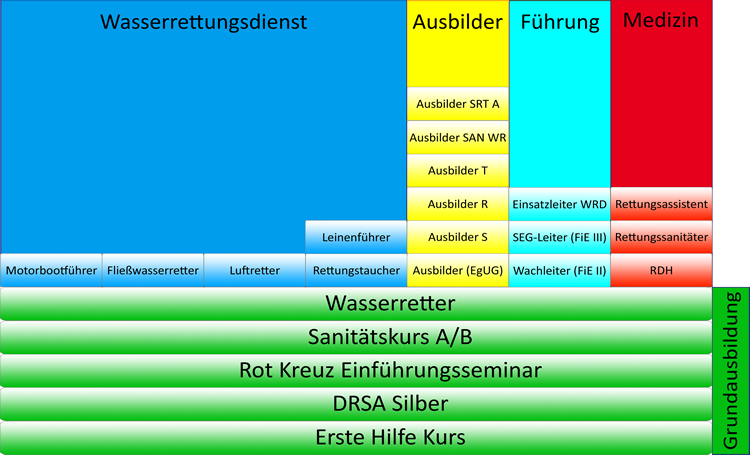
Training Levels at BRK Wasserwacht