 BRK Wasserwacht Unterhaching
Information about the Water Rescuer
Instructor at BRK Wasserwacht

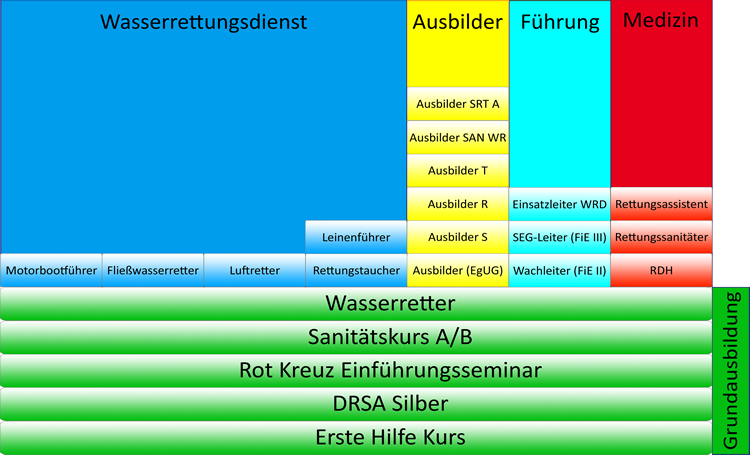
At BRK Wasserwacht, the silver rescue swimming badge is the minimum qualification for active rescue swimmers. With the paramedic courses A and B, one becomes a rescue swimmer in the water rescue service. Since 2001, there has been the advanced training to become a water rescuer (formerly SAN C). This is a prerequisite for further qualifications (rescue diver, motorboat operator, watch leader and numerous other advanced training programmes).
During training, aspiring water rescuers receive an introduction to the Medical Devices Act, radio instruction, and an advanced paramedic training specifically adapted to the water rescue service. Particular emphasis is placed on operational scenarios at and around bodies of water. The course concludes with written and practical examinations with case studies.
Water Rescuers at BRK Wasserwacht Unterhaching
Since the beginning of water rescuer training in Munich, Wasserwacht Unterhaching has been active in the training group. Currently three water rescuer instructors are active in the Munich Water Rescue Training Group, and casualty simulation group members support training with up to 20 simulated casualties per day.
Wasserwacht Unterhaching has numerous water rescuers. The water rescuer qualification has become part of the basic training. A special water rescuer group handles training and continuing education.
Water Rescuer Group Training
Training focuses on personal protective equipment, rope and equipment handling, rescue in contaminated areas, floods, cooperation with other organisations, tactical components, heavy equipment rescue, team leadership, disaster medicine and further water rescuer topics.
More about the water rescuer group can be found here!
Water Rescuer Training
Prerequisites:
- Active rescue swimmer in water rescue service
- Completed RS WRD training
- Continuing education records per DV WRD
- Valid CPR/AED recertification
- End-user digital radio training
Course Content & Duration:
A complete course comprises four modules with at least 64 teaching units, concluding with the water rescuer exam. At least 50% must be practical training. Small group training is recommended.
Module 1: "Basic Emergency Medicine Training"
- Operational basics, tactics and safety
- Emergency scenarios
- Trauma first response basics
- Teamwork and leadership
- Documentation and handover
Module 2: "Operations Training"
- Operational basics and safety
- Leadership structures
- Motor rescue boat operations
- Diving accident response
- Equipment knowledge
- Complex operational situations
Module 3: "Basic Swiftwater Rescue"
- Swiftwater rescue
- Safety
- Swimming in flowing water
- Equipment (throw rescuer, lines, knots)
- Contact rescue
Module 4: "Regional Operations Training"
- SEG operations
- Special rescue equipment
- Flood and disaster response
- Night operations
- Ice rescue
Validity
The water rescuer qualification is valid indefinitely. Regular refresher training is recommended.